
First of all, stereotypes are something that have been used in cartoons since they began. Just check out this early political cartoon.

Stereotypes!
Snakes usually represent evil, seen here as the Monopolies
Liberty is usually represented by a woman, seen here wearing our Flag, representing American Liberty.
Uncle Sam is of course a stereotype in and of itself.
In this case, the cartoon uses stereotypes to convey a message.
We see stereotypes all the time and never notice them. This is because cartoons, as well as TV and movies are visual mediums. The more you show and the less you tell the better.
Of course, this can always be used in negative ways, but its not always bad. For instance...

Cars is a great example of stereotypes.
You don't need to be explained these characters, since the movie uses Stereotypes. You don't need to have it explained why they act the way they do either for the same reason. Pixar chose to show, not tell in this case.
Of course, this movie isn't so one dimensional as to remain there. In fact, one of the main themes is to get past preconceived ideas.
This use of stereotypes pops up all the time. Just look at Aladdin.

Look at the characters. Jafar's angular face and dark features tell us he's evil. The genie's good natured face lets us know he's ok, as well the use of Blue, often a mystical color for Disney (IE, Blue Fairy from Pinocchio, Cinderella's Fairy God mother and magic dress, Blue fairy from Sleeping Beauty). Scimitars, the baggy Arabian pants, curled shoes, vests, are all stereotypes. There have been tons of cartoons of Aladdin before this movie was made and almost all of them featured these stereotypes.
This is simply how many cartoons attempt to use stereotypes to show, not tell, a story. They only have a few hours to convey something, so they need to show as much as they can as fast as they can.

This is also why many of the princesses look and act the way they do. The artists are simply using stereotypes that they grew up with to create these movies. You never need to be told why young men go after princesses, you know why. They are beautiful and desirable. How do we know this with out being told? All through the use of visuals. As time passes however, stereotypes could change as well as the audience. The movies aren't saying this is the only picture of beauty and desire. However, because of the wide spread and universal effect that this movies have had on us from our earliest childhoods, we seem to regard them as more. This is one of the problems of using stereotypes.
Also, you need to keep in mind, that several of the Disney movies that we're talking about are very old. The very fact that we still know the characters and what movies they come from is incredible.
For instance, Snow White is from 1937. What other movie characters do you even know from that time period? Maybe Charlie Chaplin or Laurel and Hardy? Cinderella is the next closest, being made in 1950, but few of us even know much of the film history from that era as well. My point being that several characters are from different eras and the new ones are simply trying to make a film in a similar style.
There are other difficulties as well with using stereotypes as well.
Now, this brings me to some difficult things. I wanted to talk about what made the Princess and the Frog so difficult to produce.
Cartoons have a long history of using stereotypes to show and not tell. This is all good and well, but when you bring that together with African Americans, it becomes difficult. The reason is that, although cartoons have had a good relationship with stereotypes, African Americans have not. In fact, people have used cartoons in particular to create some of the most hateful and nasty stereotypes in history. The horrible lasting effect can sadly still be seen today. For instance when people who were opposed to Obama becoming president, they made racist caricatures.
When you put these two histories of stereotypes together, it doesn't always mix and some people will inevitably be offended, even when people are trying their best to make something that won't offend anyone.
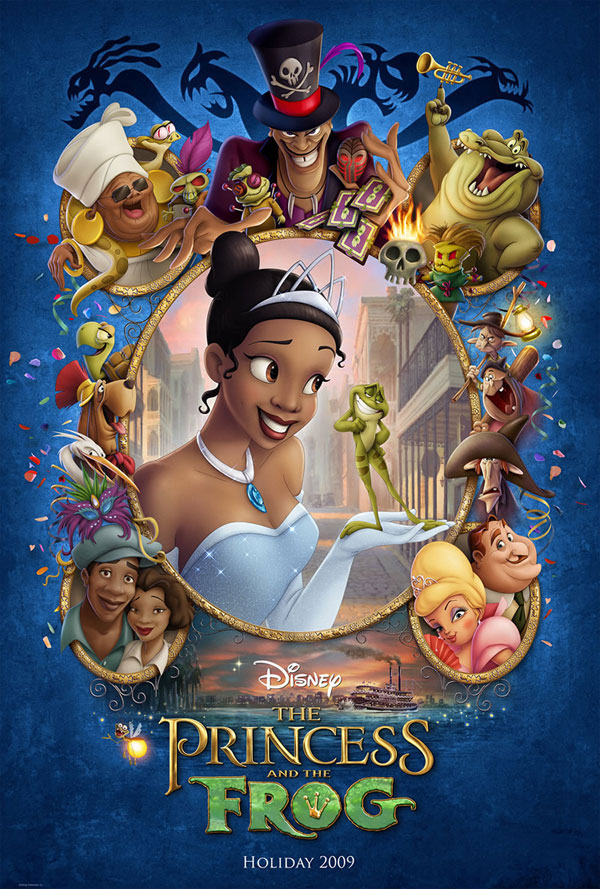
This is why it took them so long to make this movie, as well as why they seem to have quieted down about its release. It wasn't pushed in as many people's faces as say, a Pixar cartoon would be, because Disney is afraid of any kind of bad press or any one seeing any of it as a negative experience. I heard some one in class mention the character "Mama Odie" in that she didn't have teeth. She doesn't have teeth any more because, as she claims in the movie, to be over 900 years old. However, people might see this character and interpret it as Disney making a disrespectful stereotype.
This type of problem could pop up for almost every character. Giving a character too few defining features takes away from their over all identity and charm, but give them too much in the wrong way and you risk offending people.
Its really a shame too because the Princess and the Frog is one of the best animated films made in a long while by a company that isn't Pixar. However, as a society, it still seems that people aren't enjoying the film, simply because they can't get past the fact that some people in it aren't the right color.
Lastly, I want to make the point that Disney is at least has been trying. With movies like the Princess and the Frog as well as Lelo and Stich, they've tried to create main characters that aren't little thin sticks or only white.

I'm glad they've stopped making movies with thin blonds....or have they?


I think you have made a good point and I agree with you. Also, I think it's interesting what you said in the beginning, about stereotypes in early political cartoons. To me, those aren't stereotypes, it's symbolism. But that made me think, stereotypes and symbolism are very similar, in certain respects.
ReplyDeleteStereotypes and symbolism are similar, aren't they? They are used more often in movies than literature, because they are an easy way to avoid having to do a lot of character development. We see familiar personages through them, and relate quicker.
ReplyDeleteI must make a point, though, which actually strengthens Joel's point. It's only a coincidence, but Joel, your question of what we remember from the late 30s, the answer is: actually quite a lot. Here is a partial list of movies released in 1939: Dark Victory
Gone With the Wind (The best picture Oscar winner)
Goodbye, Mr. Chips
Love Affair
Mr. Smith Goes to Washington
Ninotchka
Of Mice and Men
Stagecoach
The Wizard of Oz
Wuthering Heights
The Marx Brothers At The Circus
The Hound of the Baskervilles, - the first in the Sherlock Holmes series starring Basil Rathbone and Nigel Bruce
The Hunchback of Notre Dame, directed by William Dieterle, starring Charles Laughton and Maureen O'Hara
In Name Only, starring Cary Grant, Carole Lombard and Kay Francis
Idiot's Delight, starring Clark Gable and Norma Shearer
Intermezzo, starring Ingrid Bergman and Leslie Howard
The Little Princess, starring Shirley Temple and Richard Greene
The Private Lives of Elizabeth and Essex, starring Bette Davis and Errol Flynn
You get the idea, and that's just 1939. And the Three Stooges were making comedy shorts, Zorro was in Serials (shorts shown in theatres that had timelines, and you had to come to at least one movie a week to keep up with the story).
http://en.wikipedia.org/wiki/1939_in_film
So, we see, these stereotypes DO make their way into the American vernacular and become measures of common things. Your post is outstanding.
Hannah, thanks for mentioning the point about symbolism. I didn't even think to talk about that. I feel like it adds another element to this discussion.
ReplyDeleteAnd Mr. Democrat, thanks for pointing out just how many good films came from that era. I didn't want people to think I was dismissing these films simply because they aren't well known. When I was young, my family put a big emphasis on showing me old films and I've seen many of them. My point was more along the lines of pointing out what era these movies have come from and what that means to most of us today. Many of these moves are quite famous in their own right (as they should be) however, I'd wager that most of our class hasn't seen a Marx Bros film or the Original Zorro TV series. However, Snow White is something that most everyone has seen.
But I agree with you, that these movies are great and people should make a point to enjoy them.